
How Healthy Sierra Leone (HEALS -SL) has promoted data for action
This webinar was held in November 2025 for recipients of a planning grant to develop sample registration systems in Africa. Antenneh T. Assalif from Njala University presented about how the Healthy Sierra Leone (HEAL-SL) sample registration system is designed and how it has impacted decision-making around health in the country.
Watch the webinar:
Background
Since its inception about five years ago, Sierra Leone’s sample registration system has revealed surprising facts about major causes of death, such as maternal complications, malaria, diarrhea and road traffic injuries. HEAL-SL forms Sierra Leone’s foundation for evidence-based monitoring. The system supports data-driven decisions at all levels - community, district, and national - and it has strengthened the health system’s culture of data use.
In 2019, Sierra Leone’s life expectancy was only 54 years, under-5 child mortality was 122 per 1,000 livebirths, and maternal mortality estimated at 1,120 per 100,000. However, less than 25% of deaths were reported through the vital statistics system. Most deaths occurred at home, rendering health facility data inaccurate for estimating population-level cause of death.
The sample registration system (SRS) was intended to fill this data gap. It covers about 5% of the total population, or around 297,000 people, and is nationally representative. It collects data on basic demographic information, births and deaths, then uses verbal autopsy to determine cause of death based on physician review. The process is completely electronic and includes rigorous quality checks.
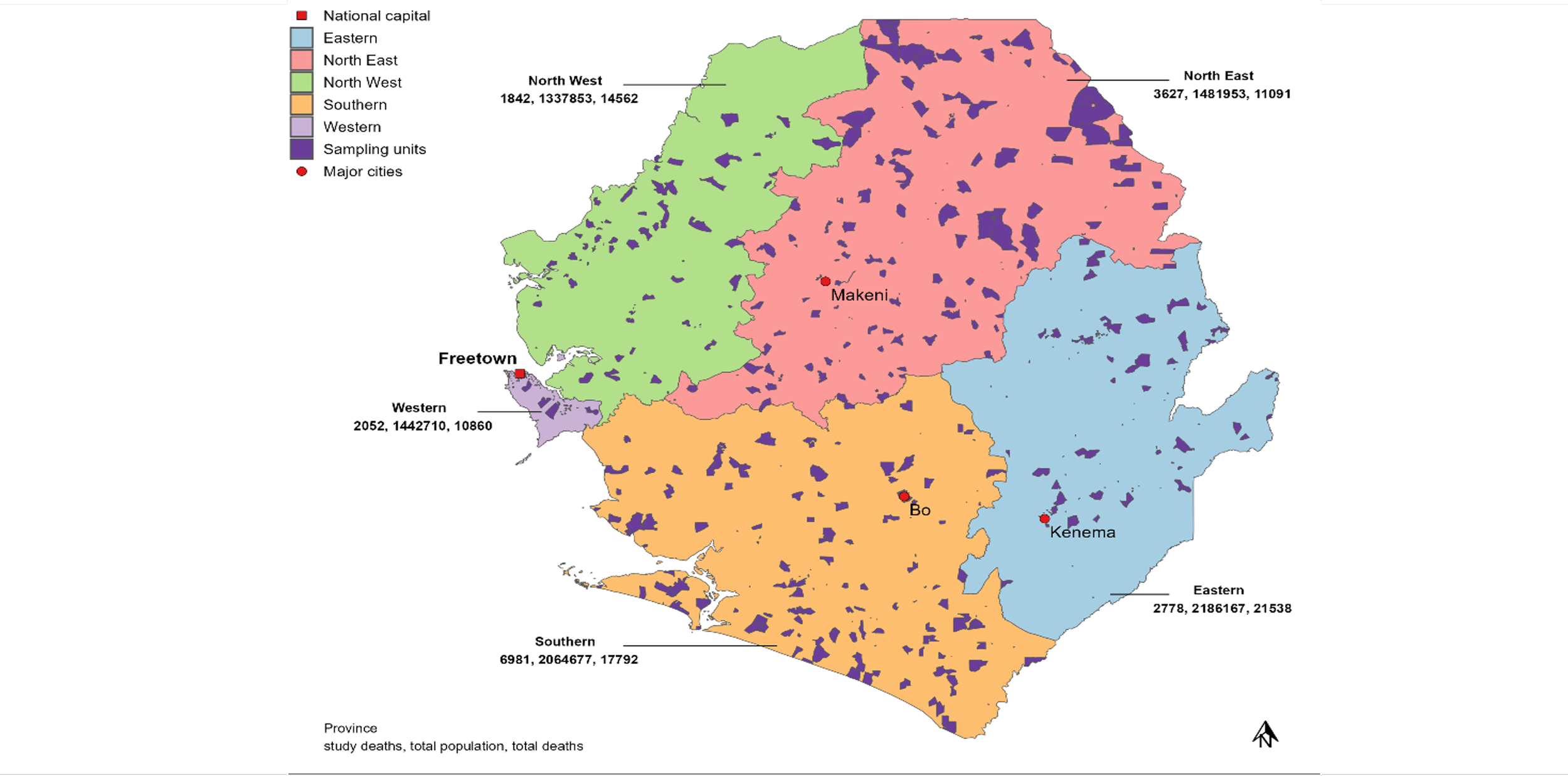
Map of data collection clusters.
The system created Sierra Leone’s first reliable maps of mortality, counting every birth and death, and understanding why people die. These maps are shared with both the Ministry of Health and other people in national leadership roles, as well as members of the communities where data is collected.
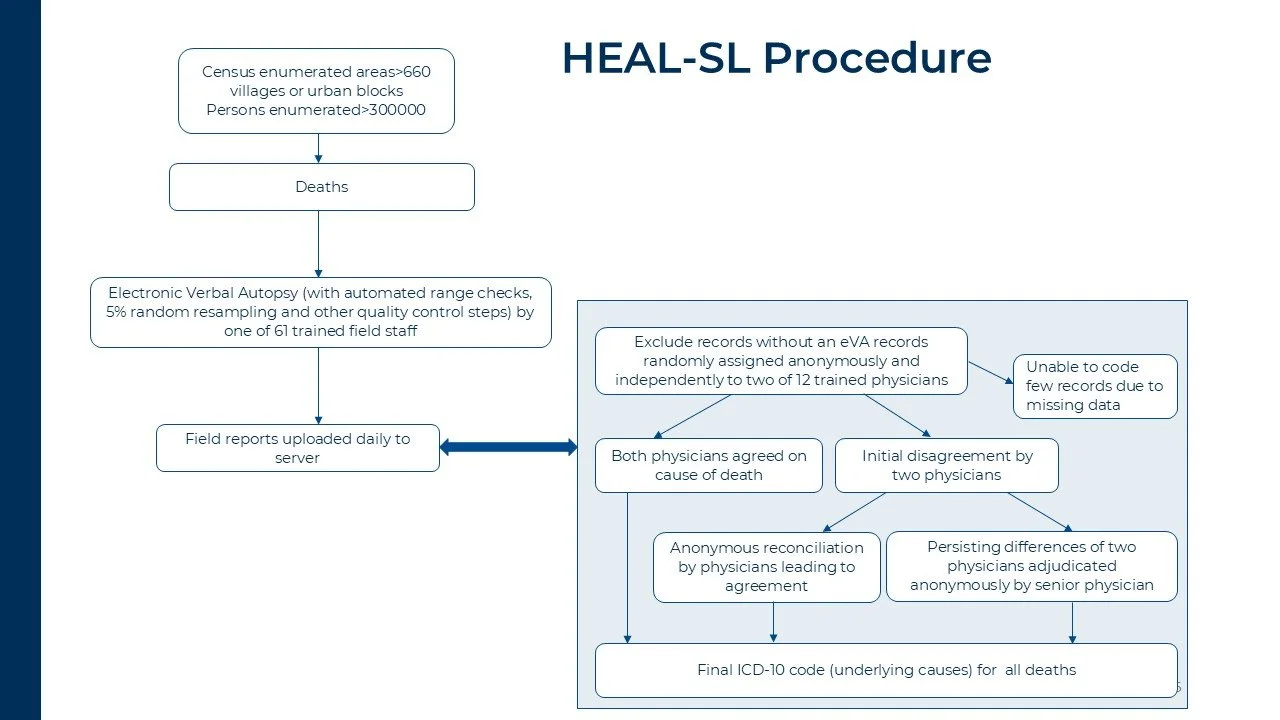
Diagram of data collection procedures.
Maternal Mortality
Some of the most surprising data came through maternal mortality estimation: SRS data showed a maternal mortality ratio (MMR) of 510 per 100,000 livebirths, half of the official World Health Organization estimate. It also showed encouraging progress: a further reduction to an MMR of about 318 by 2023. Crucially, it identified hemorrhage as the leading cause of death, which helped focus program planning for safe motherhood interventions.
Malaria
HEAL-SL also demonstrated that malaria remains the leading cause of child deaths, both at ages 1-59 months, where it causes 47% of all deaths, and at ages 5-14 years, where it causes 39% of all deaths. However, it was surprising to learn that malaria remains a top cause of death later in life, responsible for 17% of deaths among those age 15-29 and 11% of adults age 30-69. Previously, malaria had been considered mainly a disease of childhood. This highlighted the need to monitor used of preventive and treatment interventions across the lifespan. The unexpected findings led to a new validation study at Bo Hospital and were a key driver in launching the Adult Malaria Reduction Intervention (AMRI) vaccine trial (R21/Pfs230) for 6,000 adults in Sierra Leone.
RTAs and Other Epidemics
The data also brought a hidden epidemic to light: road traffic accidents. Road traffic accidents are among the top killers of people age 15-29, causing 7% of all deaths in this group. HEAL-SL mapped the problem, showing hotspots for in need of targeted interventions. Verbal autopsy data revealed that 51% of fatal road traffic accidents involved motorcycles, which helped further target safety interventions. This information improved coordination between the health and transport sectors.
This system’s mapping function also allowed provided new insights into other major causes of death, including stroke and diarrhea. Researchers used HEAL-SL data to show that hospital-based registries underestimate the true numbers of stroke cases, because they miss people who die quickly or do not seek care.
Quality of Health Services
Verbal autopsy data about availability and quality of health services has also yielded valuable information. For example, among mothers who died, 24% were more than two hours from a health facility, while for stroke and road traffic accident deaths, this was 13-15%. The data also showed that the cost of treatment was frequently a barrier to care, with cost forcing families to skip other essential payments for 25% of stroke deaths, 21% of adult malaria deaths, 19% of maternal deaths, and 14% of road traffic accident deaths. For those who reached a hospital before dying, 8% of road traffic accidents and 7% of adult malaria victims' families reported problems with obtaining the correct services. This information was used to inform the country’s universal healthcare framework.
Looking Ahead
The project’s main next step is to secure long-term, sustainable funding. They have six of the ten years of funding that they need to fully stabilize the routine surveillance. The program intends to continue supporting innovation and research, as the platform can be used for new intervention studies, such as the AMRI trial, and outbreak investigations, such as Mpox.
